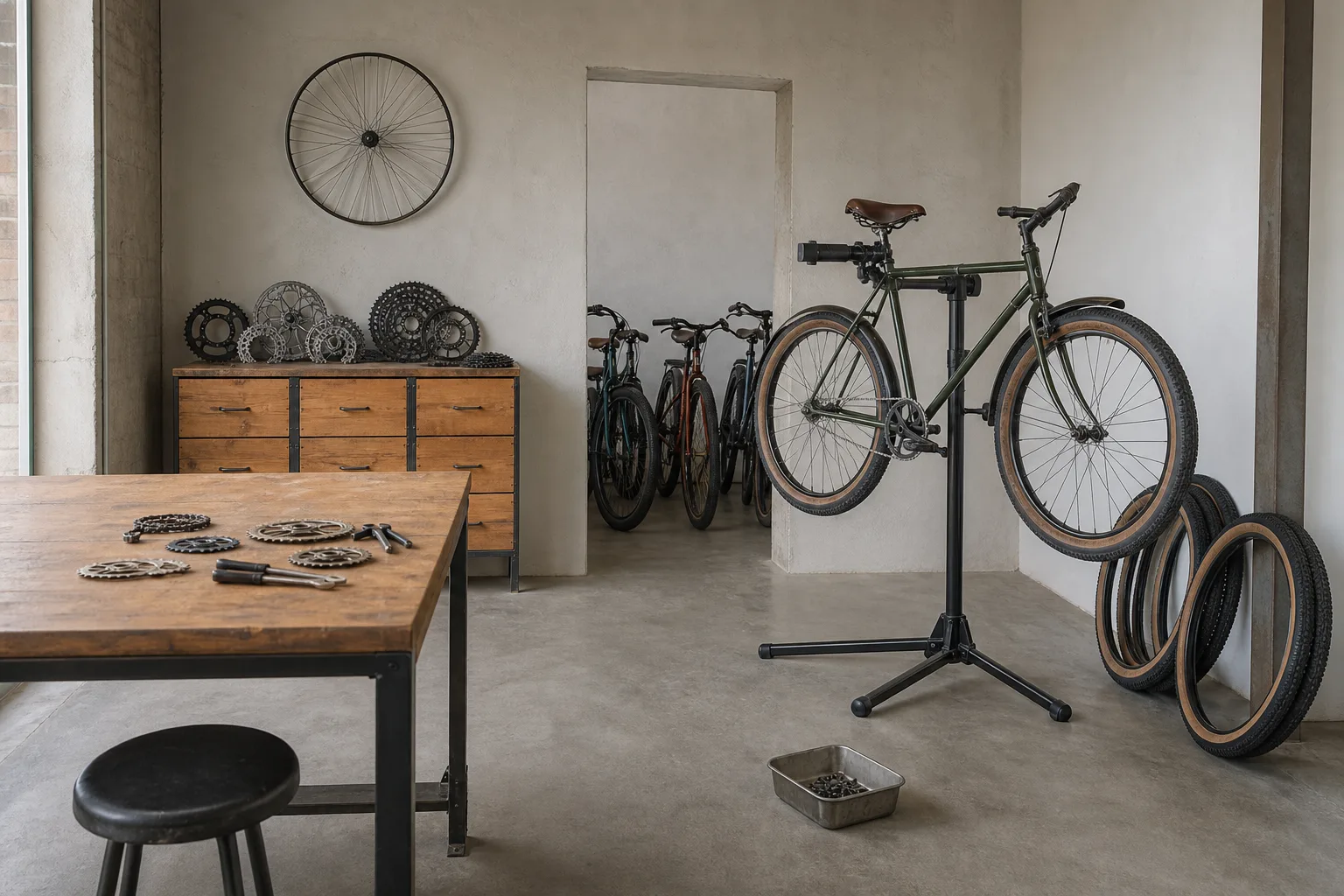
The gearing question gets decided in a showroom, in about ninety seconds, on the strength of a word like relaxed or versatile, and then it gets tested every day for years on one particular half mile of road. That order is backwards. The useful sequence is to measure the route first, in grade rather than in impressions, and then to work out which of the three common answers covers it with the least weight, cost and maintenance. A careful reader checks the numbers stamped on the parts, not the adjectives printed on the head tube.
Measure the route before you shop
Ride or walk the trip you actually intend to make, and pay attention to the two or three places where your breathing changes, because those are the only places gearing matters. A bridge approach, a highway overpass, a driveway ramp into a parking structure, the last block home: these are usually short, and their steepness is easy to overestimate from memory. The United States Geological Survey is responsible for the national elevation data that most mapping tools draw on, so a route profile from a phone app is generally close enough to tell a two percent rise from a six percent one. Write down the length of each pitch as well as its grade. A hundred feet of six percent is a different problem from a quarter mile of it.
What one speed actually holds
A single speed on an upright, wide-tyred frame is normally sold around 65 to 70 gear inches, which on a 26 inch wheel with a two-inch tyre is roughly a 44 tooth chainring against an 18 tooth cog. That gearing pedals comfortably on the flat at conversational speed, tolerates a long one or two percent drag without much complaint, and lets you stand up for a short three or four percent rise. Beyond that, on a bike weighing forty pounds with a basket on it, you will be walking. The fix is cheap and rarely offered: a 20 or 22 tooth cog drops you to the mid fifties in gear inches, costs perhaps a lunch, and trades a few miles per hour of top speed you were never using for a grade you climb twice a day.
Where a three-speed hub earns its keep
An internally geared three-speed, the Sturmey-Archer pattern or the Shimano equivalent, gives steps of roughly minus twenty-five percent, direct drive, and plus a third. Set the middle gear at your comfortable flat cruising number, around 62 to 66 gear inches, and low becomes a genuinely usable climbing gear near 47 while high covers a tailwind or a descent. The hub adds perhaps two pounds and a meaningful chunk of the purchase price, and it needs a cable adjustment once or twice a year rather than a chain line and a derailleur hanger. It shifts standing still at a traffic light, which matters more on a short urban trip than any efficiency argument, and its moving parts sit inside a sealed shell where road salt cannot reach them.
Why seven external speeds often sit unused
A seven-speed derailleur cluster on a heavy upright frame usually runs a single chainring, commonly 38 or 42 teeth, against a cassette spanning something like 14 to 28 teeth. In practice riders find two or three cogs they like and stay there, because the top gears are too tall to turn against the bike's frontal area and the lowest is only occasionally needed. The hardware is exposed to curbs, bike racks and winter grit, and the derailleur hanger is the part that bends first. It is the right answer when the route has a sustained climb of five percent or more, or when you carry groceries up a real hill, and it is the wrong answer for a flat two-mile errand with one overpass.
What to check before money changes hands
Count the teeth on the chainring and the rear cog, or ask the shop to, and convert them to gear inches with the wheel diameter you are actually buying, because a 44 by 18 on a 700c wheel is noticeably taller than the same pair on 26 inch rims. Ask what a smaller chainring or larger cog would cost fitted, and whether the frame has enough chain adjustment to take one. On a hub gear, confirm the shifter type and that a replacement cable is a stock item. These are five-minute questions with permanent consequences.
The bike that fits the route gets ridden. Deciding the gearing from the two hard blocks rather than from the flat mile between them is what makes the difference, and it costs nothing to check before you buy.